

Advantages Checklist
eBacon's exclusive bona fide fringe trust is a proven money saving $$$ solution! See all the advantages...

Integrations
Supported Accounting Packages
API

Pay stubs are more than just a piece of paper. For construction payroll, they are the primary record that workers use to verify wages, overtime, fringe benefits, tax withholdings, and job reporting. Errors on pay stubs can lead to:
Accountants, payroll specialists, and HR teams need to understand how to read and decode pay stubs so they can catch errors before they affect workers or compliance.
This guide breaks down the key components of a construction pay stub and gives you clear next steps for reviewing and verifying them.
A pay stub is a document that shows how an employee’s gross pay becomes net pay. It includes details about:
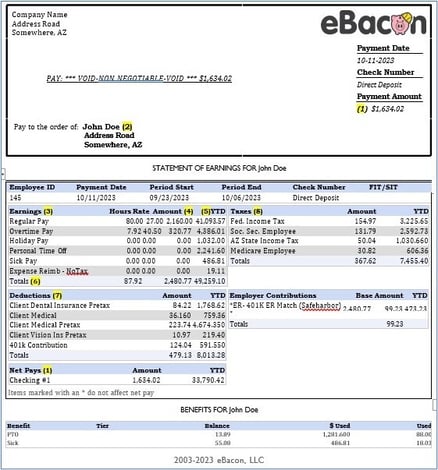
In construction payroll, pay stubs are especially important because they reflect how labor costs are allocated to jobs, how fringes are treated, and whether overtime and prevailing wages are applied correctly.
This section includes:
Payroll teams should verify that this data matches internal records. Mislabeling a classification can lead to prevailing wage errors.
The pay period shows the start and end dates for hours being paid. Accurate pay periods are critical for:
If pay periods don’t align with timecard data, investigate before issuing pay.
Construction pay stubs typically categorize hours as:
Verify that hours on the stub match timecard records. Differences are a common source of payroll disputes.
Pay rates on a construction pay stub should show:
For prevailing wage jobs, ensure that the base wage rate matches the wage determination for the classification and location.
Gross pay is the total amount earned before any deductions. It’s calculated as:
Accidental omissions or incorrect rates can inflate or deflate gross pay. Always check math.
This section includes federal, state, and local taxes. Common items shown are:
Payroll teams must confirm that withholding calculations follow current tax tables and employee withholding elections.
Benefits and deductions may include:
For prevailing wage jobs, fringe benefits must be tracked separately from deductions.
Net pay is what the employee takes home after all taxes and deductions. Confirm net pay matches payroll journal entries before issuing.
Start by verifying that hours on the pay stub match the timecards or electronic timekeeping system. Pay particular attention to:
Discrepancies between hours worked and pay stub totals are often the root of pay disputes.
Check that:
Incorrect rates can lead to back wages and audit findings.

Confirm tax withholdings align with current regulations and employee withholding status (Form W-4 / state equivalents). Mistakes here affect employee tax returns.
In construction payroll:
If fringe amounts are missing or misclassified, investigate before certifying payroll.
Ensure the net pay amount on the stub matches what was disbursed in payroll. Differences may indicate missing deductions or improper calculations.
These mistakes often show up first on pay stubs. Catching them early avoids audit adjustments and employee disputes later.
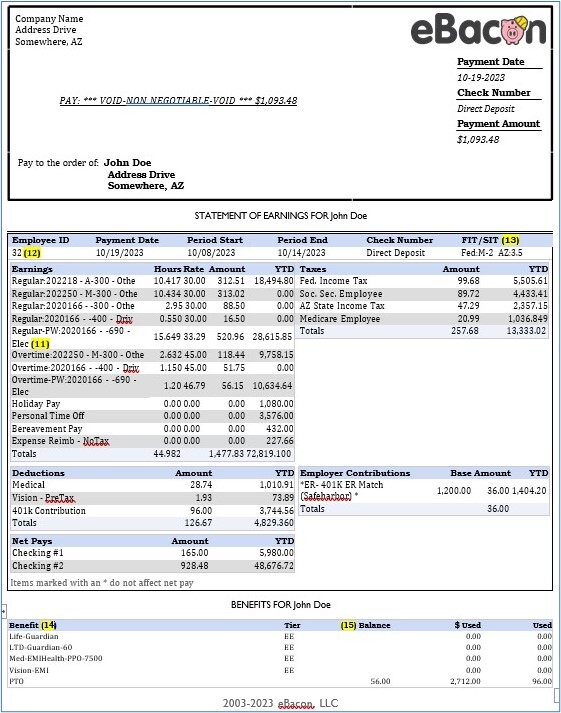
On prevailing wage jobs, pay stubs are often the first line of evidence auditors use to confirm compliance.
Payroll teams should ensure that:
Strong pay stub audits strengthen certified payroll accuracy and reduce compliance risk.

To improve pay stub accuracy and reduce compliance exposure:
Many teams use platforms like eBacon to automate wage rate checks, fringe tracking, and certified payroll reporting to avoid manual errors.
See how eBacon simplifies pay stub validation and compliance. Book a quick demo.

Incorrect overtime calculations and misclassified fringe benefits are among the most common errors.
Yes, but fringe benefits should be accounted for separately and not treated as taxable wages unless paid as cash in lieu.
Ideally every pay period before direct deposit or paychecks are issued.
Investigate immediately before pay is finalized to prevent incorrect payments.
The material presented here is educational in nature and is not intended to be, nor should be relied upon, as legal or financial advice. Please consult with an attorney or financial professional for advice.
.jpg?width=153&height=191&name=HensleysPaving-thumb%201%20(1).jpg)
