

Advantages Checklist
eBacon's exclusive bona fide fringe trust is a proven money saving $$$ solution! See all the advantages...

Integrations
Supported Accounting Packages
API

Yes—many agencies require a certified payroll report even if no work was performed during a given week. This is typically submitted as a “no work performed” report to document that zero labor occurred and maintain reporting continuity. Certified payroll no-work-performed reports are required on many public works projects when a construction payroll reporting period has no labor activity. Even when no employees worked, agencies often still expect documentation to confirm compliance continuity.
For construction payroll teams, this matters because missing a required report can delay payments, trigger compliance flags, or raise audit questions. Many contractors assume no payroll means no reporting. That assumption causes problems.
This guide explains when no work performed reports are required, how they work, and how to handle them correctly across public agencies.
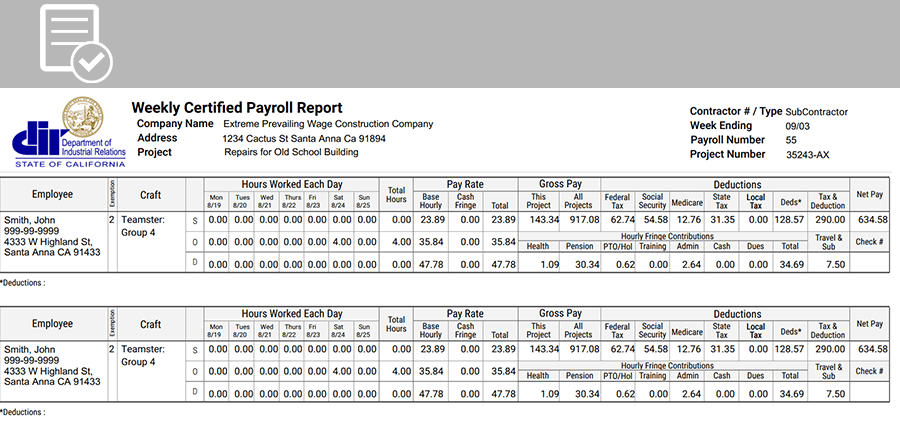
A no-work-performed report is a certified payroll submission stating that no employees performed covered work during a specific reporting period.
It does not list workers, wages, or hours. Instead, it documents that zero labor occurred for that week on a public works project.
Key point: No work performed does not always mean no report required.


Requirements depend on the funding agency and project rules.
In general, a no work performed report may be required when:
Federal agencies, state labor departments, and prime contractors may all have different expectations.
The U.S. Department of Labor allows agencies to set reporting requirements under the Davis-Bacon Act. Many state agencies follow similar practices.
Missing or mishandling no work performed reports can create real consequences.
Common impacts include:
For payroll and compliance teams, consistency matters as much as accuracy. Agencies want a complete record showing when work happened and when it did not.
Do not assume. Review the contract, labor compliance manual, or agency guidance. Some agencies require weekly submissions no matter what.

Some agencies accept a simple statement. Others require a certified payroll form marked “no work performed.” Follow the specific instructions.
The report must cover the same payroll week used for regular certified payroll submissions. Gaps raise questions.
If the agency requires certification, the statement must still be signed or electronically certified.
Store no-work-performed reports with your certified payroll records. Auditors often check continuity first.
These mistakes are easy to avoid with a clear process.
Your payroll software may not be set up to help with the submission of either type of report. In this instance, you can use the final section of form WH-347 to help you create a Statement of Non-Performance. It may look something like this:
Date:
Payroll number:
I (Name of Signatory Party) (Title), do hereby state that I pay or supervise the payment of the persons employed by (Contractor or Subcontractor name) on the (Project name).
During the payroll period commencing on (Start date) and ending on (End date), no work was performed on the construction site of (Project name).
(Signature of authorized person and title)
(Date)
Just remember to keep a detailed record of all reports you submit, including non-performance statements. This can be crucial in supporting your compliance claims if you find yourself being audited. You may also want to consider switching to a certified payroll platform like eBacon that helps with compliance requirements like this. This will make compliance easier, less risky, and reduce the amount of time needed to handle certified payroll requirements.
Watch this video and learn all about the new WH-347 certified payroll form and how to complete it.
A public school project pauses for two weeks due to permitting delays. The contractor submits no work performed reports for both weeks. When work resumes, payments process without delay.
Another contractor skips reporting during downtime. The agency flags the gap. Payment is held until explanations and retroactive statements are provided.
The difference is process, not effort.
If your projects involve public funding, assume reporting continuity matters.
See how eBacon simplifies certified payroll reporting. Book a quick demo.
Sometimes. Many agencies require a no work performed report.
No. Skipping payroll without documentation creates compliance gaps.
Some agencies allow a WH-347 marked “no work performed.”
The contracting agency, funding source, or prime contractor sets the requirement.
The material presented here is educational in nature and is not intended to be, nor should be relied upon, as legal or financial advice. Please consult with an attorney or financial professional for advice.
.jpg?width=153&height=191&name=HensleysPaving-thumb%201%20(1).jpg)
