

Fringe Benefit Management That Reduces Labor Costs and Keeps You Compliant

- Paying Cash Fringe
- Compliance Risk
- Administrative Burden
Paying Cash Fringe
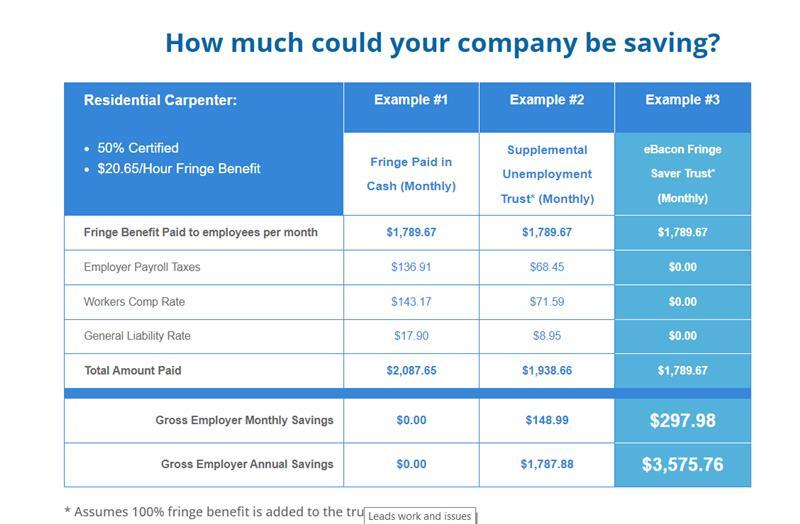
The problem with paying fringe benefits as cash wages is that it increases a contractor's taxable payroll. That means higher Social Security, Medicare, workers' comp, and general liability costs on every dollar.
Compliance Risk
Davis-Bacon, ERISA, IRS 401(k) and prevailing wage regulations governing fringe benefit trusts are complex. Improper distributions, miscalculated contributions, or trust mismanagement create audit exposure for contractors. It can result in financial penalties - regardless of whether you manage your own prevailing wage rates or use a certified payroll system.
Administrative Burden
Tracking fringe allocations, employee elections, and benefit distributions across multiple projects and worker classifications is time-consuming and error-prone without a system designed for prevailing wage work.
Everything You Need to Manage Prevailing Wage Fringe Benefits
Bona Fide Fringe Trust
eBacon's IRS-compliant bona fide fringe trust converts prevailing wage fringe obligations into pre-tax 401(k) contributions, eliminating payroll taxes on those dollars. Employers save on Social Security, Medicare, workers' comp, and general liability costs with every paycheck processed.

Real-Time Fringe Validation
Built-in validation checks fringe benefit calculations and check amounts in real time, flagging errors before they reach payroll. Catch compliance issues, over/underpayments, and missing data before they become costly problems.

Flexible Employee Access
Employees can receive fringe benefits as a weekly cash distribution via direct deposit or pay card. They can also choose to keep their funds in the trust as a tax-preferred investment for retirement. Give workers the power and flexibility to manage their money how they like.

Tax Savings on Every Paycheck
Because trust contributions are pre-tax and do not increase wages, they are not subject to the same payroll taxes as cash fringe payments. Social Security, Medicare, workers' comp, and general liability costs add up significantly across the workforce and with every project. Once contractors see how much money a fringe trust saves them, they always wish they had done it sooner.
Versatile Benefit Options
Employees can direct fringe allocations into 401(k) plans, Health Reimbursement Accounts, FSA, Dependent Care Accounts, college savings plans, and more. A competitive benefits package helps attract and retain skilled workers in a tight labor market.
Expert Trust Administration
eBacon handles deduction processing, employee enrollment, eligibility tracking, and detailed reporting as the Third-Party Administrator. This enables HR teams to stay focused on higher-value work while eBacon manages compliance with prevailing wage and IRS requirements.
How it Works
- 1. Set Up Your Trust
- 2. Assign Determinations
- 3. Contributions Process
- 4. Employees Choose
- 5. Audit Ready
Set Up Your Trust
Connect your projects and prevailing wage fringe obligation rates to eBacon's bona fide fringe trust during a guided onboarding process.
Assign Determinations (State/Davis-Bacon/SCA) by project
Apply a determination to each project and worker classification so contributions are always calculated accurately. eBacon will apply the accurate fringe credits, if applicable, and put the remaining employee fringes into the trust.
Contributions Process Pre-Tax
Each pay period, fringe obligations are deposited into the trust as pre-tax 401(k) contributions, reducing your employer taxable payroll burden right away.
Employees Choose Their Benefits
Workers select how to use their fringe allocations: weekly cash distribution via direct deposit or pay card, or tax-preferred savings through 401(k), HRA, or Dependent Care accounts.
Stay Compliant and Audit-Ready
eBacon maintains organized records of all contributions, distributions, and employee elections. Be confident, compliant and audit-ready at all times, in accordance with Davis-Bacon, ERISA, and IRS requirements.
Everyone wins with our fringe trust
Make the switch from paying fringe in cash to a fringe trust. It's easy!
And not only will you save money, your employees will be happy, too! That’s because offering employees a fringe trust gives them options with the power to choose:
- Receive fringe benefits via direct deposit weekly, like a paycheck.
- Receive fringe benefits on a convenient pay card each week.
- Invest fringe benefits in a 401(k), HSA or FSA.
Download this PDF for employers to learn how it works
Download this PDF for CPA and tax professional reference
Fringe Benefit FAQs
A bona fide fringe trust is an IRS-compliant plan that allows prevailing wage contractors to fulfill fringe benefit obligations through pre-tax employer contributions into a qualifying 401(k) plan. Unlike paying fringe in cash, contributions to the trust do not increase wages and are not subject to additional payroll taxes - reducing costs for employers while giving employees flexible access to their benefits.
NO. eBacon's fringe trust is a pre-tax employer contribution into a qualifying 401(k) plan followed by an optional distribution to the employee. It is not a safe-harbor match or a deferred payment plan. It is specifically structured to meet bona fide fringe benefit plan requirements under Davis-Bacon and ERISA regulations.
Because trust contributions are pre-tax and do not increase taxable wages, they are not subject to the same payroll taxes as cash fringe payments. Most contractors see meaningful reductions in Social Security, Medicare, workers' comp premiums, and general liability costs. However, employees remain subject to applicable federal and state income taxes when funds are distributed from the trust.
YES. Employees can choose to receive fringe allocations as a weekly cash distribution via direct deposit or pay card through the auto-distribution feature, while remaining compliant with prevailing wage regulations. They can also keep funds in the trust for retirement savings or other tax-preferred uses. Any in-service withdrawal is taxed at the time of withdrawal and reported to the IRS on a 1099-R.