

Advantages Checklist
eBacon's exclusive bona fide fringe trust is a proven money saving $$$ solution! See all the advantages...

Integrations
Supported Accounting Packages
API

When evaluating certified payroll software vs spreadsheets, most contractors are not simply comparing tools. They are trying to determine whether their current payroll process can support growth, reduce compliance risk, and handle increasing public works payroll requirements.

Spreadsheets are often the starting point for certified payroll reporting. They are familiar, inexpensive, and flexible. However, as prevailing wage projects increase, many payroll teams discover that spreadsheets require significant manual work and become harder to manage consistently.
Certified payroll software is designed to automate reporting, improve visibility, and reduce manual compliance tasks. The question is not whether spreadsheets work. The question is whether they continue to work efficiently as project volume grows.
For contractors managing certified payroll reporting, prevailing wage compliance, fringe benefit tracking, and multiple active jobs, the answer often becomes clear quickly.

Spreadsheets are manual tools used to track payroll information, wage rates, classifications, fringe benefits, and certified payroll reporting data.
Many contractors use spreadsheets to:
While spreadsheets offer flexibility, they rely heavily on manual entry and user oversight.
Certified payroll software is designed specifically to help contractors manage certified payroll reporting and prevailing wage compliance.
Depending on the platform, features may include:
The primary goal is reducing manual work while improving compliance accuracy.
Construction payroll is significantly more complex than standard payroll.
Payroll teams may need to manage:
Federal contractors and subcontractors on covered Davis-Bacon projects must submit weekly certified payroll information and maintain payroll records.
As project volume increases, payroll processes become more difficult to manage manually.

Spreadsheets depend heavily on manual entry.
Common risks include:
A single error can affect multiple payroll periods before being discovered.
Certified payroll software can automate calculations and standardize reporting processes.
Benefits may include:
Advantage: Certified Payroll Software
Spreadsheets can support compliance, but compliance management remains largely manual.
Payroll teams must independently track:
As projects increase, compliance oversight becomes more difficult.
 Certified Payroll Software
Many prevailing wage software platforms are designed specifically for labor compliance construction workflows.
Features often include:
Advantage: Certified Payroll Software
Manual spreadsheet processes typically require:
Administrative workload often grows as project volume increases.
Software can reduce repetitive administrative tasks by automating portions of the payroll process.
Payroll teams often spend less time:
Advantage: Certified Payroll Software
Spreadsheets have a low upfront cost.
However, hidden costs may include:
Software requires an investment, but many contractors adopt payroll technology to reduce administrative labor and improve operational efficiency.
The total value depends on project volume, compliance complexity, and growth plans.
Advantage: Depends on Company Size and Project Volume
Spreadsheets often work well for a small number of projects.
As contractors add:
manual processes become increasingly difficult to maintain.
Construction payroll software is generally designed to scale as project volume grows.
Many systems support:
Advantage: Certified Payroll Software
Payroll audits often require extensive record gathering when information is stored across multiple spreadsheets and folders.
Many systems maintain centralized payroll records and audit documentation.
This may help contractors respond more efficiently to agency requests and construction payroll audits.
Advantage: Certified Payroll Software
Spreadsheets may still work for contractors who:
For smaller operations, spreadsheets can remain manageable if compliance complexity is low.
Contractors often begin evaluating software when they experience:
These are often signs that manual processes are becoming difficult to scale.
The decision between certified payroll software vs spreadsheets depends on project volume, compliance complexity, and long-term growth goals.
For many contractors, spreadsheets are the starting point.
As public works payroll responsibilities increase, software often becomes a way to improve:
eBacon helps contractors manage certified payroll reporting, prevailing wage compliance, fringe benefit tracking, labor compliance construction workflows, and public works payroll operations in a centralized system.
See how eBacon simplifies certified payroll reporting and prevailing wage compliance. Book a quick demo.
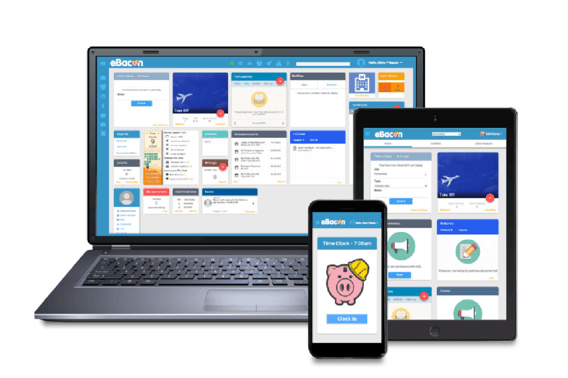
For contractors managing multiple prevailing wage projects, certified payroll software often provides stronger compliance visibility, reporting efficiency, and scalability than spreadsheets.
Yes. Many contractors use spreadsheets for certified payroll reporting, especially on smaller projects. However, manual processes can become difficult to manage as project volume increases.
Manual entry errors, classification mistakes, fringe benefit calculation issues, and version control problems are among the most common risks.
Many contractors begin evaluating software when they experience reporting delays, increased project volume, compliance concerns, or growing administrative workload.


.jpg?width=153&height=191&name=HensleysPaving-thumb%201%20(1).jpg)
