

Advantages Checklist
eBacon's exclusive bona fide fringe trust is a proven money saving $$$ solution! See all the advantages...

Integrations
Supported Accounting Packages
API
Free Construction Self-Check
Benchmark your business compared to the best-in-class methods… in certified payroll, field operations and more. You get a score with specific insights on what to fix first and why it matters.
Actionable Insights + Smart Solutions


To calculate fringe benefits in certified payroll, start with the fringe rate on the wage determination, subtract the annualized hourly credit for any bona fide benefits you provide, and pay the rest as cash. Fringe is owed for every hour worked on a covered project, including overtime.
A wrong fringe calculation can mean back wages, withheld payments, and audit findings, even when the base wage is right.

Fringe benefits in certified payroll are the hourly benefit amount on a wage determination that contractors must pay on top of the base wage, through bona fide benefit plans, cash, or a mix of both. The base wage plus the fringe rate equals the prevailing wage, and certified payroll is the weekly report showing both were paid.

The formula is:
Hourly fringe credit = Annual cost of the benefit ÷ Total hours the worker worked that year on all jobs.
All jobs means Davis-Bacon work and private work. The Department of Labor requires this annualization under 29 CFR 5.25(c).
If a contractor pays $4,950 a year for a worker’s health insurance and the worker logs 1,920 total hours, the credit is $2.58 per hour.
Calculate fringe benefits in certified payroll each week by checking the wage determination, annualizing each benefit, comparing the credit to the required rate, and paying any shortfall as cash.
Each classification lists a base rate and a separate fringe rate. A $32.50 base rate plus an $8.25 fringe rate makes a $40.75 hourly obligation. If fringe is shown as a percentage, figure it as a percentage of the base rate.
Fringe can be paid through bona fide benefit plans, as cash to the worker, or as a combination.
Divide each benefit’s annual cost by the worker’s total hours on all jobs. For a worker with 1,920 total hours:
Subtract the total credit from the fringe rate. Here, $2.58 + $3.00 = $5.58, so $2.67 per hour is still owed against the $8.25 fringe rate.
Pay the shortfall as cash instead of fringe, which is taxable wages. For a 40-hour week, $2.67 × 40 = $106.80. Overtime hours get the same straight-time cash amount, with no half-time premium on it.
| Line item | Hourly amount |
|---|---|
| Base rate | $32.50 |
| Health insurance credit | $2.58 |
| Retirement plan credit | $3.00 |
| Cash in lieu of fringe | $2.67 |
| Total paid per hour | $40.75 |
Report each worker’s fringe credit and cash in lieu on that week’s certified payroll. The revised WH-347 has separate entries for both, and the older form expired September 30, 2026. eBacon annualizes fringe credits automatically and generates the WH-347 from the same payroll data. State prevailing wage projects can add their own fringe rules, so check them before you submit.
Accurate fringe comes from actual hours, current costs, and documented math.
The most common fringe mistakes are skipping annualization and claiming costs that don’t qualify.
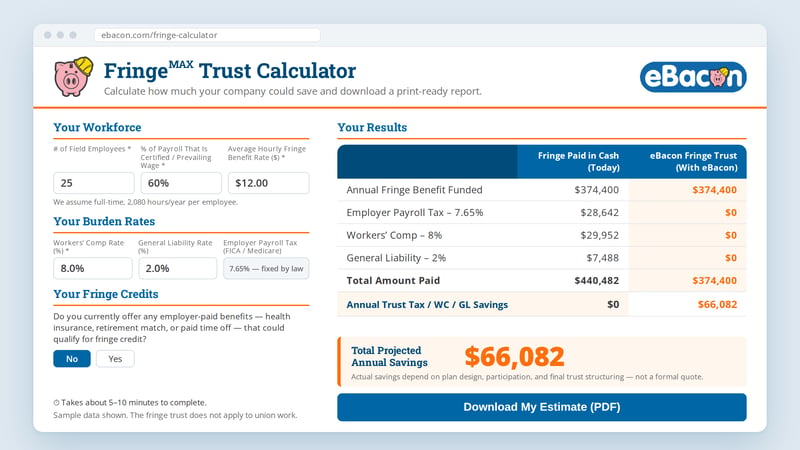
Contractors can lower fringe costs by moving fringe out of taxable cash wages and into a bona fide fringe trust. eBacon’s bona fide fringe trust converts prevailing wage fringe into pre-tax 401(k) contributions each pay period. The fringe trust does not apply to union work.
eBacon’s Fringe Benefits page explains how fringe calculation, the trust, and WH-347 reporting work together. To see your own numbers, try the FringeMAX Trust Calculator.
eBacon is the only construction-focused platform featuring certified payroll with a money-saving fringe trust. All-in-one software with scheduling, GPS-enabled time tracking, safety system, and inventory management for contractors with 15 to 500 employees.
Book a demo to see eBacon annualize fringe credits, route remaining fringe into the trust or cash wages, and build the WH-347 from one payroll run. Call 833-4-eBacon or request your free demo.

Start with the fringe rate on the wage determination for the worker’s classification. Subtract the annualized hourly credit for each bona fide benefit, then pay any remaining amount as cash instead of fringe. Use the actual hours worked that week.
Yes, in most cases. The DOL requires contractors to spread benefit costs across all hours worked on public and private jobs. A defined contribution pension plan is excepted when it offers immediate participation, vests within the first 500 hours worked, is not continuous in nature, and doesn’t cover both covered and private work. Other plans need a written exception from the Wage and Hour Division.
Yes. Contractors may pay the full fringe rate as cash in lieu of fringe. That cash is taxable wages and must appear on the certified payroll for the week it was earned.
Yes. Fringe is owed for every hour worked on a covered project, including overtime. The overtime premium applies to the base rate only, so no half-time is owed on cash paid in lieu of fringe.
Qualifying benefits include health insurance, retirement plans, life and disability insurance, vacation and holiday pay, and registered apprenticeship costs paid through a legally enforceable plan. Benefits required by law, per diem, travel, lodging, and the contractor’s own administrative costs don’t qualify.
The material presented here is educational in nature and is not intended to be, nor should it be relied upon, as legal or financial advice. Please consult with an attorney or financial professional for advice.
